Sales: (819) 568-9999
Service: (819) 568-9999
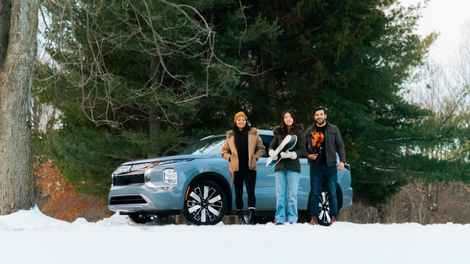
Are you considering driving a Mitsubishi Outlander PHEV in winter? Before choosing a plug-in hybrid SUV, it is natural to have questions about electric range, home charging and how the vehicle performs when temperatures drop.
For drivers in Gatineau and the Outaouais, these questions are part of everyday life. Between commuting to Ottawa, running family errands and taking weekend trips, your needs change with the weather and the distances you travel.
The 2026 Mitsubishi Outlander PHEV combines a rechargeable battery, two electric motors and a gasoline engine. Here is what you should know to understand how it operates during the colder months and prepare for your trips.
At Rallye Mitsubishi, our team can help you determine whether this type of powertrain fits your routine and charging options.
According to Mitsubishi Canada, the 2026 Outlander PHEV has a 22.7 kWh battery and an advertised electric range of 72 km. This figure provides a point of comparison for the vehicle; it is not a guaranteed winter range.
Actual range varies depending on factors such as outside temperature, speed, terrain and the use of vehicle features. Mitsubishi notes that electric range decreases during the coldest months of winter.
When planning your trips, allow a margin rather than assuming that every charge will let you travel exactly 72 km.
Cold weather affects the battery’s operating conditions. Cabin heating and defrosting also require energy, which can reduce the distance available in electric mode.
The same trip can therefore use a different amount of energy depending on whether you drive in mild weather or on a very cold day. Speed and route conditions also contribute to this variation.
There is no single Outlander PHEV winter range figure that applies to every driver. Your driving habits and operating conditions matter just as much as the distance you need to travel.
The distance you travel, the time available for charging and access to an outlet at home are good starting points. Discuss your routine with our team to better assess whether the Outlander PHEV meets your needs.
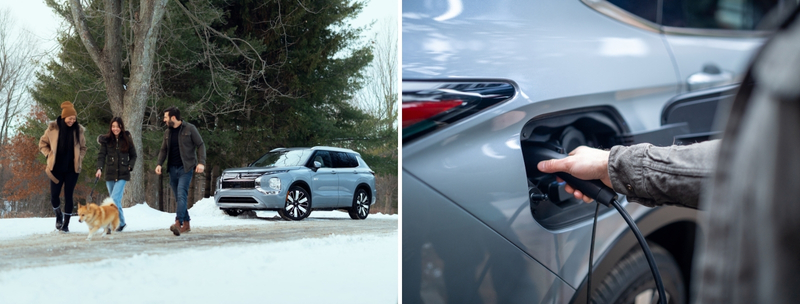
The 2026 Outlander PHEV can be charged at home using a 120 V power supply with the included cable, or a compatible 240 V Level 2 charging station.
Your choice depends on factors such as how much energy you need to recover between trips and how many hours the vehicle remains parked.
| Charging type | Approximate time for a full charge | What to consider |
|---|---|---|
| Level 1 — 120 V | Approximately 16.5 hours | Slower charging with the included cable; allow enough time between trips. |
| Level 2 — 240 V | Approximately 6.5 hours | Faster home charging with a compatible charging station installed by a qualified electrician. |
These times are approximate and are not guaranteed winter charging times. Charging conditions, temperature and the battery’s state of charge can affect the time required.
For Level 1 charging, Mitsubishi specifies using a dedicated 120 V outlet. Before choosing a home charging solution, have your electrical installation checked and follow the instructions for both the vehicle and the charging equipment.
The Outlander PHEV allows you to schedule cabin heating using the functions provided in the vehicle. The 2026 model’s press kit also indicates that heating can be used while charging to prepare the cabin before departure.
Remote controls and connected services depend on equipment and service terms. Check which functions are available on your chosen trim with the Rallye Mitsubishi team.
The Canadian owner’s handbook for the 2026 Outlander PHEV recommends connecting the normal charging cable when parking for extended periods in extreme cold, including overnight, to help improve cold-weather readiness.
However, Mitsubishi notes that the vehicle may not start if the battery becomes too cold. The handbook gives the example of an ambient temperature of -30 °C for more than 10 hours. This is an example of extreme conditions, rather than a universal operating threshold.
Plugging in therefore does not guarantee starting in every condition. Follow the messages displayed on the dashboard and consult the manual for your vehicle.
Yes. EV Priority Mode favours electric driving, but it does not guarantee that the gasoline engine will always remain off. The system adjusts its operation to driving demands and the selected modes.
The Outlander PHEV offers features including:
Once the available electric range has been used, the vehicle can continue driving in hybrid mode, provided it has fuel and conditions allow normal operation. The gasoline engine does not eliminate limitations caused by a battery that is too cold.
The 2026 Outlander PHEV comes standard with Super All-Wheel Control, or S-AWC. Its drive mode selector includes a Snow mode, designed to improve traction and stability on snow-covered or slippery roads.
These technologies support the driver, but they do not replace four suitable winter tires or a speed adapted to the conditions.
To prepare your vehicle, read our guide to choosing and installing Mitsubishi winter tires.
Use your next appointment to discuss tires, maintenance and winter operating instructions specific to your Outlander PHEV.
When evaluating a plug-in hybrid, start with your actual routine. Regular access to charging allows you to make more frequent use of the available electric energy.
Before choosing your vehicle, ask yourself these questions:
For a commute between Gatineau and Ottawa, for example, it is best to consider the complete round trip along with your other daily driving. In winter, allow a margin for variations in range.
The 72 km figure is the advertised electric range for the 2026 model. Actual distance varies and may decrease in cold weather. This figure does not guarantee 72 km of electric driving on every winter trip.
No. Level 1 charging is possible with the included cable and a suitable 120 V outlet. However, a 240 V Level 2 charging station reduces the time needed to recover a full charge.
No. It favours electric driving, but the engine may run depending on the system’s needs and the settings used.
No. S-AWC contributes to traction and vehicle control. Suitable tires remain essential for grip when braking and turning.
Would you like to better understand charging, driving modes or the specifics of using the Outlander PHEV in winter? Our team can answer your questions and help you make your choice.
Visit us at 1247 Saint-Joseph Boulevard in Gatineau, or call us at 819 568-9999 to discuss the 2026 model and test-drive options.